Friday, 16 September 2011

Mexican Gulf Cartel gangster Manuel Alquisires Garcia paraded with his bling

Mexican marines have recaptured a fugitive suspected trafficker, who had been arrested 13 years earlier, along with the man who was to become the Gulf Cartel's top leader.

Manuel Alquisires Garcia is the cartel's alleged finance officer, the Mexican navy said in a statement, and he was captured by marines on Saturday in the city of Tampico.

Among the items seized allegedly from Manuel Alquisires Garcia included a gold plated pistol, wads of cash and jewellery.

Recaptured: Mexican Navy marines escort Manuel Alquisires Garcia, alias 'El Meme,' during a presentation to the press in Mexico City

Recaptured: Mexican Navy marines escort Manuel Alquisires Garcia, alias 'El Meme,' during a presentation to the press in Mexico City

Alquisires, aka ‘El Meme’, was originally arrested in June 1998 along with Osiel Cardenas Guillen.

Cardenas later escaped and went on to become the Gulf Cartel's leader before being recaptured in 2003.


He was extradited to the U.S. in 2006 and sentenced last year to 25 years in federal prison.

Alquisires escaped from a prison in Matamoros, across the border from Brownsville, Texas, in 2002, three years after his arrest, prosecutors said yesterday.

The golden gun: A gold plated pistol and jewellery were among the items allegedly seized from Mauel Alquisires Garcia in Mexico

The golden gun: A gold plated pistol and jewellery were among the items allegedly seized from Mauel Alquisires Garcia in Mexico


Bling seized: Part of the arsenal and personal things of alleged financial agent of the drug 'Cartel del Golfo', Manuel Alquisires Garcia, including wads of cash

Bling seized: Part of the arsenal and personal things of alleged financial agent of the drug 'Cartel del Golfo', Manuel Alquisires Garcia, including wads of cash

Zetas hitmen, who at the time were still allied to the Gulf Cartel, allegedly orchestrated his escape.

He had evaded authorities until Saturday.

Alquisires is suspected of trafficking cocaine from Guatemala for the Gulf Cartel.

Also on Monday, the Mexican navy said it captured 13 gunmen, including a suspect in the killing of a marine, who said to be members of the Zetas drug cartel.

The navy said in a statement the men were arrested Friday in the Gulf coast state of Veracruz and were carrying grenades and computers. 

Mass of weapons: The arsenal and personal items allegedly belonging to Garcia were shown during a presentation to the press in Mexico City

Mass of weapons: The arsenal and personal items allegedly belonging to Garcia were shown during a presentation to the press in Mexico City


Under arrest: Mexican marines escort alleged financial agent of the drug 'Cartel del Golfo', Manuel Alquisires Garcia, aka 'El Meme' and also know as Agustin Sanchez Morua

Under arrest: Mexican marines escort alleged financial agent of the drug 'Cartel del Golfo', Manuel Alquisires Garcia, aka 'El Meme' and also know as Agustin Sanchez Morua


Detained again: Alquisires was originally arrested in June 1998 along with Osiel Cardenas Guillen

Detained again: Alquisires was originally arrested in June 1998 along with Osiel Cardenas Guillen




Thursday, 15 September 2011

Fury over 'link' of drug arrests to Jodie's death


SPANISH police investigating the circumstances surrounding Jodie Nieman's death made nine arrests last week. Although police are certain the Kenley beautician died from a heart attack, it is not clear whether her death was drug-related. ​ MISSED: Jodie Nieman An investigation has been launched into drugs supply in Ibiza and police announced last Thursday that they had arrested nine men after seizing cocaine, thousands of ecstasy pills, steroids and laboratory equipment. One of the men is from Croydon but it is not suggested Ms Nieman, who died just days before her 20th birthday on July 15, knew him. The former nail technician's mother Debbie, of Waterbourne Way, Kenley, said she was "disappointed and angry" Spanish police had linked the arrests with her daughter. She said: "We still don't know if Jodie took any pills. The doctor in Ibiza said they weren't told she had taken any tablets. "Until we have results saying she took any drugs, we just don't know and it is upsetting because we are still waiting on tests." Spanish police said most of the pills found are known as Pink Rock Star, similar to those thought to have caused the death of Ms Nieman and the poisoning of others in July, officers added. The UK's Serious Organised Crime Agency took part in the operation against a mostly-British gang which travelled to Ibiza to feed the demand from the summer influx of clubbers. Detectives arrested five British men, including a 39-year-old from Croydon, three from Ireland and one from Poland. They were being questioned by officers from the Guardia Civil on suspicion of various drugs offences. The former Riddlesdown student was just three days into her holiday when she had a heart attack on a night out at the Space club in the Playa d'en Bossa resort. The teenager's funeral took place at Croydon Crematorium on August 16. Mum Debbie said her 19-year-old daughter was a "stylish princess" who would defend her friends to the end. Ms Nieman added: "She had champagne on the plane over and it came in a plastic glass – Jodie just said: 'Who has champagne in a plastic glass?' "That was just Jodie. Every day another person tells me they knew Jodie and they went to the funeral. I didn't know she was so loved."

Three New Brunswick Smoke Shops Raided in "Bath Salts" Bust, Six People Arrested


Middlesex County Prosecutor's Office has announced that three smoke shops in New Brunswick and a gas station in East Brunswick were raided and charged in the sale of illegal drugs. According to the Prosecutor's Office, the raids began on Aug. 2 after four months of investigative work and netted the following arrests: Jarnail Sandhu, 25, of Sayreville, owner of the Shell gas station located at 1010 Route 18 in East Brunswick, was arrested and charged with distribution of bath salts and synthetic marijuana; possession of bath salts and synthetic marijuana and possession of drug paraphernalia. He was jailed with bail set at $100,000, with no 10 percent option. Sandhu's mother, Charanjit K. Sandhu, 56, of Nanuet, N.Y., was also arrested and released on her own recognizance. She faces the same charges as her son. Ayman S. Al-Nsairat, 40, of East Brunswick, owner of the Amsterdam Smoke Shop, 29 Easton Ave. in New Brunswick. He was charged with possession of toxic chemicals and possession of drug paraphernalia, and was released on his own recognizance. Maria M. Almanzar, 20, of Union City at the Amsterdam Smoke Shop. She was charged with possession of toxic chemicals and possession of drug paraphernalia, and distribution of toxic chemicals, and was released on her own recognizance. Lukasz M. Poplawski, 21, of Staten Island, N.Y. at the Amsterdam Smoke Shop. He was charged with possession of toxic chemicals and possession of drug paraphernalia, and distribution of toxic chemicals, and was released on his own recognizance. Ranmanjeet K. Dhillon, 24, of Woodbridge, at the Jamaican Discount Smoke Shop at 38-A Easton Ave. in New Brunswick. Dhillon was charged with possession and distribution of toxic chemicals and possession of drug paraphernalia, and was released on her own recognizance. Additionally, the Jamaican Smoke Shop at 40 Easton Ave. in New Brunswick was also raided, and "Some illegal substances and drug paraphernalia were seized," according to the Prosecutor's office. No arrests were made at that location. Bath Salts are mix of chemicals that mimic the effects of cocaine and methamphetamines and were banned earlier this year. 6,547 bags, jars and vials containing synthetic marijuana and bath salts were also seized by police during the investigation, marked for sale for between $20 to $30 each, according to the Prosecutor's Office. Police also seized 2,914 pipes, bongs and hookahs, 193 digital scales, 357 canisters containing nitrous oxide, 13 imitation handguns used to fire blanks, and 46 containers designed to conceal illicit drugs, according to the Prosecutor's Office. Packaging material, grinders, cigars and rolling papers, "All identified as products used to prepare and help sell the illicit drugs," according to the Prosecutor's Office. $25,145 in cash from the sales of the illegal drugs was also seized. More than $163,000 in synthetic Marijuana and bath salts were seized. Members of the Middlesex County Prosecutor’s Gangs, Guns and Drugs Task Force are handling the investigation, assisted by police in New Brunswick, East Brunswick and Sayreville, according to the Prosecutor's Office
Feds tightlipped on county drug arrests


Few details are being released following the arrest of 11 people in Santa Cruz County in connection with a federal drug investigation. Those arrested include Marciano Ramirez Cruz, an elderly Watsonville resident whose son is charged in a federal indictment that accuses 24 people of being involved in a drug ring. Cruz was arrested Monday morning when U.S. Drug Enforcement Administration agents executed a federal search warrant at his son's Watsonville home. Agents didn't find the younger man, Marciano Ramirez Gomez, at the home but they did find his father there, according to documents filed in federal court. While searching the older man's bedroom closet, agents found an ounce of a substance believed to be heroin, the documents state. They also reported finding a storage tub containing $30,000 wrapped in aluminum foil and plastic wrap, a .38 caliber revolver and a brown paper bag containing 50 rounds of .38 caliber ammunition. Cruz was charged with possessing heroin with intent to distribute. He remained in federal custody Wednesday. "He has a detention hearing Friday and I'm very hopeful that he'll be released," said his attorney, Peter Leeming, who believes his client is being unfairly included in the investigation. "He's an elderly gentleman without a significant history." Cruz's son is among 24 people named in a federal indictment alleging numerous drug charges, including conspiracy to distribute 50 grams or Advertisement more of methamphetamine, distribution of heroin, drug trafficking and money laundering. Casey McEnry, a spokeswoman for the DEA's San Francisco branch, said she couldn't comment on the case and referred comments to U.S. Attorney Jack Gillund, who wouldn't comment further on the case Wednesday. Eleven arrests were made in total in Santa Cruz County Monday in connection with the indictment. Of those, nine are named in the indictment. A 10th defendant also named in the indictment was arrested Monday in Milpitas. Jerardo Rodriguez-Guerrera, who isn't named in the indictment, was arrested after he left his Santa Cruz apartment early Monday morning. He was carrying 30 grams of heroin, 1.1 grams of meth and 1.2 grams of cocaine, and a search of his apartment turned up 176.5 more grams of heroin, according to court documents. He's charged with intent to distribute heroin. Calls to his attorney were not returned Wednesday. Local law enforcement departments in Santa Cruz County have been asked not to comment on the case, as it is a pending federal investigation.

Holloway lawyer smuggled drugs into Pentonville Prison in oversized shoes


Five people are facing years behind bars after smuggling drugs and mobile phones into Pentonville Prison – including a lawyer who stuffed illicit goods into his oversized shoes. Ritesh Brahmbhatt, 31, took phones, high-strength cannabis and the stimulant mephedrone into the prison in Caledonian Road, Holloway, in a pair of size-12 slip-ons bought from menswear store High and Mighty. The revelations come within a month of a scathing report by the prison’s independent monitoring board, which revealed a drug problem is stoking gang trouble and violence in the jail. It also emerged that a drugs counsellor from Canonbury is to stand trial next year accused of smuggling cannabis into the prison in an unrelated case. Dismissed Brahmbhatt, who was dismissed from law firm Mordi and Co in Holloway Road, Holloway, when caught, pleaded guilty to conspiracy to smuggle drugs, mobile phones and other prohibited items into Pentonville in July – but details have just emerged after his four accomplices were convicted on Friday after denying the charge. David Sterling, 28, of Mallory Close, Bromley-by-Bow, Desmond Brown, 27, of Montague Road, Leytonstone, Brown’s girlfriend Danielle Porter, 24, of Saltern Court, Barking, and Calvin Chance, 26, of Birch Grove, Leytonstone, were convicted at Blackfriars Crown Court following a trial. Rufuz D’Cruz, prosecuting, said: “Ritesh Brahmbhatt entered into a crude criminal conspiracy to smuggle prohibited items into prison with his clients, Sterling and Brown, who at that time were serving prisoners, and Chance and Porter.” Mr D’Cruz said he abused his position of trust and “chose to routinely undermine the rule of law”. The gang was snared after a prison officer spotted his suspiciously high number of legal visits – 15 between February and September in 2009. He was caught with a mobile phone, earphones, a pair of electronic scales and a small quantity of mephedrone, or “meow meow”, in his right shoe and 25g of high-strength “skunk” cannabis in his left, while a further 80g of cannabis was stuffed down his trousers. The lawyer intended to pass the contraband to inmate Sterling, who was wearing a full-length Muslim robe. Two more mobile phones – which can fetch up to £1,000 each inside – were discovered in his jail locker and an envelope with £300 of cash. Police found text messages and financial information linking the five, while several phone calls and visits were known to have taken place. Nearly £20,000 passed through bank accounts belonging to Brahmbhatt, Porter and two others. The five defendants have been remanded in custody awaiting sentencing. A Prison Service spokesman said: “We are working hard to keep contraband out of prison, using a range of security measures to reduce drug supply, including working closely with police forces and carrying out random mandatory drug tests.”

Aussie Poker Pro David Saab Gaoled For Drug Smuggling


Professional poker player David Saab from Victoria in Australia faces a lengthy period away from the game after being convicted of smuggling 14.6kg of cocaine into the country.  The drugs, which had an estimated street value of AU$6.5 million (£4.22m) were hidden inside agricultural machinery imported from Canada.  Saab was convicted alongside fellow players Darren Francis Hughes and Robert Alan Remeeus; he faces 14 years in prison while his accomplices both received 8-year sentences. The highlight of Saab’s poker career was his victory in the Manila leg of the Asian Poker Tour in 2008, a win which netted him $280,000.  He has also appeared on tv screens in Britain, when he participated in a heat of the UK Open.  He came 46th in the Main Event at the 2008 World Series of Poker.  His total live tournament earnings amount to more than $550,000. Sentencing Saab, Judge Liz Gaynor said: “It is clear that you were the principal organiser in Australia of this importation and would derive the most benefit from it.”

Briton arrested for drug smuggling


Customs and Excise officers at Soekarno-Hatta International Airport have foiled an attempt to smuggle 6.5 kilograms of crystal methamphetamine (shabu-shabu) worth Rp 13 billion and arrested a British national. The head of the Customs Office, Oza Olivia, said the suspect was identified as Gareth G.D, 32, who flew from Istanbul, Turkey and arrived at the airport with Turkish Airlines on Tuesday evening. “Members of our tactical unit conducted profile analyses of passengers at Terminal II-D and began to suspect him of carrying illegal items,” she told reporters on Wednesday. Oza said officers were suspicious and decided to search the suspect’s luggage. They found the drugs hidden inside the luggage. The suspect, a construction worker in his home country, later confessed that he received an order from a Turkish man, whom he identified as A, to transport the drug to Jakarta and was promised US$1,000 when the delivery was made. Oza claimed that by intercepting the drug delivery, her agency managed to prevent thousands of youths becoming drug addicts. She also said that in collaboration with the National Narcotics Agency, the Customs Office is still investigating the case. Drug smuggling attempts through the country’s main international gate continues to rise despite the threat of the death penalty. Drug smugglers can be charged under Article 113 of the 2009 Law on Narcotics, which carries a possible death sentence.

Tuesday, 13 September 2011

Woman caught bringing heroin to her prison pal


WOMAN pal of a man jailed over a €440m drugs seizure has been caught smuggling €6,000 of heroin into his prison. The middle-aged woman was caught by prison officers last week when she arrived at the Midlands Prison for a visit to Joe Daly (44). He is serving a 25-year sentence after being convicted of possessing the biggest cocaine haul in the State's history -- a seizure of 1.5 tonnes of cocaine at Dunlough Bay in 2007. Prison staff contacted gardai, who then arrested the woman. She was brought to Portlaoise Garda Station where she was questioned by detectives before being released without charge. A file is now being prepared for the DPP. Captured Sources say if the heroin had got into the jail, it would have had a value of "well over four times" the estimated street value that gardai put on the drug. The woman was not allowed to visit English national Daly after being caught with the drugs. Daly and three other English criminals are serving lengthy jail terms for their role in the plot to smuggle €440m worth of cocaine into Ireland in July 2007. Martin Wanden (48), police- killer Perry Wharrie (51), Gerard Hagan (27) and Daly were captured after diesel, instead of petrol, was put into the fuel tanks of their boat, which was carrying the drugs off the coast of Co Cork. When the vessel capsized, 62 bales of cocaine weighing over 1.5 tonnes were thrown into stormy seas, scuppering a huge drugs operation that had been months in the planning. Liverpool criminal Hagan admitted his role in the enterprise and was jailed for 10 years. However the other three men contested the charges but were convicted after a marathon 10-week trial at Cork Circuit Criminal Court which heard from 200 witnesses. Two of the defendants claimed in direct evidence that they were entirely the victims of circumstances, coincidence and bad luck. Joe Daly said he had only gone to west Cork as a favour for his brother, who had wanted a RIB delivered. But it would later emerge that Joe Daly's brother was Michael Daly (50) -- a former Metropolitan Police detective who is now serving combined sentences totalling 29 years in a UK prison in relation to the Co Cork plot and another cocaine importation plot. Gardai believe that Joe Daly became involved in the drugs smuggling operation through his older brother, Michael. Daly presented a defence that depicted him as very much under the influence of the brother. Children Born in London to Irish parents from west Cork, Daly worked as a bricklayer with his own business, JD Bricklaying, is married with three children and lived in Bexley, Kent. It emerged that he had a number of previous convictions in the UK for offences including threatening and abusive behaviour, assaults on police officers and possessing a blade. During the trial, his uncle, Tom Lydon, told how Daly visited him on the day before the drugs seizure and watched the Munster football final between Cork and Kerry on TV. He described him as very obliging -- "the first man to come around" if anyone needed help.

shut down drive-through drug operation near University Mall, expect more arrests


One by one, motorists arrived, rolling down windows and giving up cash, as they would at a fast-food restaurant. This drive-through opened at 11 a.m. some days, but lunch was never on the menu. Instead, customers could order cocaine, oxycodone, ecstasy and marijuana. Guns, too. At a news conference Wednesday, the Hillsborough County Sheriff's Office announced that it had broken up a drug trafficking ring that caught even investigators by surprise. About 11 months ago, deputies began building cases against two men reputed to be dealing drugs in a neighborhood near University Mall. Investigators thought Zavien Brand, 28, and Joseph Nurse, 35, might lead them to a few more people, maybe six or eight, said sheriff's Maj. J.R. Burton. But the small undercover probe soon turned into a larger investigation — dubbed Operation Pandora's Box — as deputies realized the area's loose-knit group of dealers included dozens of people. On Wednesday, sheriff's officials announced they had 54 warrants and, as of 4 p.m., 32 arrests, most on drug and gun possession charges. "We had no idea this was going on," Burton said. They focused on several addresses in the neighborhood near Nebraska and Fletcher avenues. The drive-through was at the Pines I Apartments at 11720 N 14th St., deputies said. Deputies took 29 guns off the street, including seven assault rifles and two weapons believed to be linked to shootings in the area. Also seized: about 1.3 pounds of crack cocaine, 0.64 ounces of powder cocaine, 0.25 ounces of oxycodone and some ecstasy — valued at about $75,000 total, Burton said. Burton hopes the operation sends a message to an area that has long struggled with crime, and he wants residents to know that deputies aren't done. Brand was charged with dealing crack cocaine and being a felon in possession of a gun. Nurse was charged with dealing crack cocaine, marijuana and stolen property. Deputies planned to continue executing search warrants until they arrest all 54 suspects.

DEA Bans Synthetic Cocaine Masked As Bath Salts


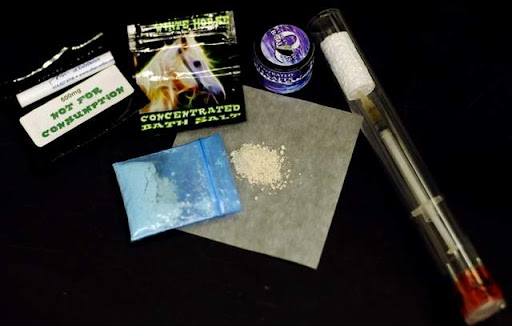
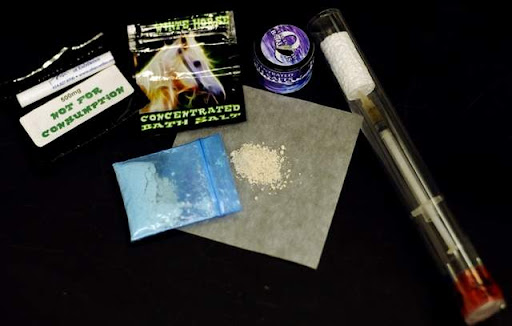
The U.S Drug Enforcement Agency's war on drugs continues with a nationwide ban of synthetic cocaine. Labeled as bath salts, the hallucinogenic drug has become more available in the Grand Junction area as part of a trend seen across the country. In response to increased emergency room visits, the federal agency has moved to emergency control these synthetic stimulants. This action makes it illegal to possess or sell Mephedrone, Methylenedioxypyrovalerone (MDPV), and Methylone or any products containing them for the next year. These chemicals are most often found in forms of 'legal ecstasy' or 'legal cocaine.' During the temporary ban, the DEA will team up with the U.S. Department of Health and Human Services to further study whether these chemicals should be permanently banned. In June, we introduced you to these bath salts in this article. Back then, they were an unregulated drug taking the place of recently banned synthetic forms of marijuana. "It is actually like a synthetic cocaine slash methamphetamine," Jim Schrant with the DEA told us at the time. "So, it's really the worst of both." The bath salts sell at a price of $40 per gram. They are mainly sold at smoke shops. But, in June, Schrant told us that his agency could not find any local dealers. Today, there are at least two. "They're putting it into packaging which is pleasing to the eye with market names of "Blue Dreams," things like that," Schrant said. "And, they're intentionally trying to target that young adult crowd." As part of this emergency control, businesses and citizens have 30 days to get rid of the banned products. At that time, the DEA will publish a Final Order in the Federal Register making the drugs Scheduled 1 substances. That category is the harshest and is reserved for unsafe, highly abused chemicals with no known medical use in the U.S. Violating that law is punishable by jail time. Employees at smoke shops in the area tell us that synthetic cocaine isn't that popular. But, local high school students have heard all about it. "I don't think they care if it's legal," Grand Junction High School freshman Hannah Rady said of some of her classmates. "Nobody does." Just like K2 and Spice, bath salts are labeled "not for human consumption." But, these students say that is not stopping anyone and neither is the law. "People just ask me 'Have you done spice before?' I'm just like, 'No,'" GJHS freshman Emilio Lazcano said. He knows Governor John Hickenlooper made those forms of synthetic marijuana illegal starting July 1, but he says fellow classmates continue to tell bother about it. "They're like 'Oh, well you're supposed to smoke it like this and that,' and I'm like 'Oh, well cool. I'm not really into that stuff.'" "They tell us that it doesn't make their eyes red, so it's way easier to bypass by your parents," GJHS junior Joe Gedscad added. The most common symptoms of these synthetic stimulants include impaired perception, reduced motor control, disorientation, extreme paranoia, and violent episodes. The DEA says the long-term physical and psychological effects are not known but potentially severe. Including Colorado, 33 states have already taken action to control or ban other synthetic stimulants. Most states pass these laws after the DEA files an emergency control on certain chemicals.

South London men face furniture drug smuggling charges


Six men have gone on trial accused of conspiring to smuggle more than £2.5m of cocaine into the country. Kevin Hill, 27, of Cartmel Gardens, Morden, Wayne Smith, 19, of Westmoreland Way, Mitcham and Carl Charles, 33, of Yorkshire Road, Mitcham, face charges of attemtping to import 13.5kg of the drug. Three other men Craig Hughes, 35, from Orpington, Conrad Crandon, 55, from Edmonton and Terence Tremblett, 32, from Brixton, also face the same charge. The offences date back to October and November, in 2009, when border agency officers at Tilbury Docks, in Essex, flagged up a container holding a number of items of wicker furniture and brush mats. After closer inspection, the jury heard, the officers found the brush mats had been injected with cocaine which, when separated, came to a total of more than £2.5m. Simon Wild, prosecuting, told the court that a respectable removal firm, called Grants of Cheam, based in Coomber Lane, Croydon, had allegedly received a phone call from a Keith Thompson in late October, 2009, who said he wanted to store a shipment. Grants of Cheam, unknowingly, agreed to take on the shipment but they did not hear from Mr Thompson for two weeks, the court heard. On November 10, 2009, Mr Thompson allegedly arranged for the furniture and mats to be delivered and they arrived that day. There followed a series of arrests after the items had reached Croydon and all six men were charged with conspiracy to smuggle, which they all deny. The trial, which started at Croydon Crown Court on Wednesday (September 7), is expected to last three weeks.

Vicente Zambada's lawyers claim he and other cartel leaders were granted immunity by U.S. agents

Vicente Zambada's lawyers claim he and other cartel leaders were granted immunity by U.S. agents — and carte blanche to smuggle cocaine over the border — in exchange for intelligence about rival cartels engaged in bloody turf wars in Mexico.

Controversial defence: Vicente Zambada's claim could throw new light on how U.S. authorities deal with Mexican drug cartels

Controversial defence: Vicente Zambada's claim could throw new light on how U.S. authorities deal with Mexican drug cartels

Experts scoff at the claim, which U.S. prosecutors are expected to answer in a filing Friday in federal court.

But records filed in support of his proposed defence have offered a peek at the sordid world of Mexico's largest drug syndicate, the Sinaloa cartel, which is run by his father, Ismael Zambada, and Mexico's most wanted man, Joaquin 'El Chapo' Guzman.

It's a world of brutality, greed and snitching, and federal agents would love to have the younger Zambada pass along more intelligence, especially if it could help bring down his family's operation or lead to the capture of Guzman, a billionaire who escaped from a Mexican prison in a laundry truck in 2001.

Main man: Vicente's father Ismael Zambada, godfather of the Sinaloa cartel, pictured at a party in 1993

Main man: Vicente's father Ismael Zambada, godfather of the Sinaloa cartel, pictured at a party in 1993

'It comes down to whether he would be willing to give up his dad or Guzman,' said David Shirk, who heads the Trans-Border Institute at the University of San Diego.

'Would he be willing to give up his own dad? It seems unlikely.'

Zambada, 35, has rarely been seen since his 2009 arrest in Mexico City, after which Mexican authorities paraded him before TV cameras in a stylish black blazer and dark blue jeans.

His suave image was a sharp contrast to a photo of him with moustache and cowboy hat released by the U.S. Treasury Department in 2007.

He may have upgraded his look after he assumed control over cartel logistics in 2008 and, federal officials say, received authority to order assassinations. 

Mexico's most wanted man: Joaquin 'El Chapo' Guzman, who escaped from prison in a laundry truck

Mexico's most wanted man: Joaquin 'El Chapo' Guzman, who escaped from prison in a laundry truck

He was arrested and extradited to Chicago a year later to face trafficking conspiracy charges punishable by up to life in prison.

The Sinaloa cartel is one of Mexico's most powerful.

Named after the Pacific coast state of the same name, it controls trafficking on the border with California and is battling rival cartels in an effort to expand east along the 2,000-mile-long U.S.-Mexico border.

Accustomed to luxury in Mexico, Zambada has been held in a 10ft by 6ft cell in Chicago, is often served meals that have gone cold and hasn't been outside in 18 months, his attorneys say.

U.S. District Court Judge Ruben Castillo told the government on Thursday to file a response to those complaints.

'It comes down to whether he would be willing to give up his own dad. It seems unlikely'

Armed marshals led the shackled Zambada into Thursday's hearing.

He appeared at ease, even smiling and winking at a woman sitting on a spectators' bench.

Castillo will decide later whether Zambada's provocative immunity claim has any credibility, but many experts said they were skeptical.

'Personally, I think it is a bunch of malarkey,' said Scott Stewart, who analyzes Mexico's cartels for the Texas-based Stratfor global intelligence company.

'I mean, what the defence is saying is that a huge amount of cocaine was allowed to pass into the United States unimpeded.

'Why would you even have sought his extradition if there was this potential backlash?"

U.S. prosecutors briefly discounted Zambada's claim in one filing, but more details are expected in Friday's documents.

A spokesman for U.S. Atty. Patrick Fitzgerald would not comment on the allegation.

Neither would a Washington spokesman for the U.S. Drug Enforcement Agency, whose agents Zambada claims to have dealt with in Mexico.

However, clandestine intelligence deals are not uncommon, and conspiracy theories abound in Mexico about the government going easy on one cartel to keep the others under control.


Customs seize huge quantity of heroin in Karachi


Drug Enforcement Cell (DEC) of the Pakistan Customs’ Model Customs Collectorate of Preventive, Karachi airport on Monday recovered and seized 73.5 kilogrammes of fine quality heroin concealed in a huge consignment of herbal medicines. In pursuance of an authentic information passed on by the Additional Collector of Customs, Jinnah International Airport, Manzoor Hussain Memon to the effect that an attempt would be made to smuggle contraband heroin powder out of Pakistan under the garb of medicines in commercial quantity in connivance with Customs officials, a surveillance team under assistant collector, Jinnah International Airport, was constituted for mounting discrete watch over all the outgoing passengers and their baggage. During the course of surveillance, the team intercepted a Pakistani passenger Ghulam Mustafa in the early hours on Aug 21, with his four suitcases when he entered the customs departure hall to take Qatar Airways flight QR-319 for Dhaka via Doha (Qatar). Initial scanning of his baggage indicated the presence of medicine boxes inside all four suitcases. He was, therefore, detained and his baggage was thoroughly examined. Upon examination, the suitcases were found to contain heroin in huge quantity (735 packets) of herbal medicines packets kept beneath a small quantity of mixed allopathic medicines for deceiving the law enforcement staff. As per labels on the packets the herbal medicines were ought to be in paste form. However, when unpacked all the packets were found to contain off-white heroin powder of fine quality instead of herbal medicine pastes. The heroin powder, so recovered, was found to be 73.5 kilogrammes upon weighment. It is worth mentioning here that in the recent years, this is the biggest haul of the heroin recovered from the accompanied baggage of an outgoing passenger at Jinnah International Airport. Another aspect of the case is that the passenger had not only taken a deceptive route to Dhaka via Doha despite availability of daily direct fights to Dhaka from Karachi to hoodwink the customs staff. He entered the departure hall at Sehri time when a number of the law enforcement officers were busy in taking Sehri. Moreover, scrutiny of the passenger’s travel documents reveals that he is in fact a Bengali holding Aliens Registration Card as well as a Computerised National Identity Card that stands expired in 2009. Consequent upon recovery and seizure of contraband narcotics, the accused passenger, as well as two customs officials, who were facilitating in clearance, has been arrested and a prosecution case under Control of Narcotics Substances Act, 1997 has been registered. Third customs official involved in the case is absconding. Efforts are being made to arrest him also. Further investigations are in progress. staff report

Troy men found with crack, heroin during traffic stop


Police arrested two Troy men found with drugs Monday evening. An officer stopped a car on 4th Street, just north of Congress Street, around 5:45 p.m., and found the driver, Kevin Peters, 25, did not have a license. The passenger, Shawn Maple, 33, provided a false name. Police say when the officer went back to his patrol car, Peters and Maple took off, but the officer pulled in front of their vehicle to cut it off. When they seized the car, police say they found 45 grams of crack cocaine, 15 grams of heroin, and a large amount of cash. Peters was charged with criminal possession of a controlled substance, aggravated unlicensed operation and unregistered motor vehicle, and improper or unsafe turn. Maple is also facing several charges, including criminal possession of a narcotic with intent to sell, and false personation. Police did not make it known when Peters and Maple will be back in court.

Feds charge Colombian drug lord called ‘Loco Barrera’ and two partners


One of Colombia’s most-wanted drug traffickers with alleged ties to a narco-terrorist organization has been charged in Miami along with two other “high-level” partners, U.S. authorities said Monday. Daniel Barrera-Barrera, indicted in Miami on cocaine-smuggling conspiracy charges, operates mainly in the eastern part of Colombia between Bogota and the Venezuelan border. There, he maintains a partnership with the U.S.-designated terrorist group known as the FARC, composed of leftist guerrillas who allegedly play a major part in Colombia’s drug trade. The Colombian government has offered a $2.7 million reward for information leading to the capture of the defendant, aka “Loco Barrera,” who remains at large. In March, the Treasury Department designated Barrera-Barrera, 42, as a “specially designated narcotics trafficker,” because of his significant role in the international drug trade. In Miami, Barrera-Barrerra was charged with two brothers, Javier Fernandez-Barrero, 43, and Orlando Fernandez-Barrero, 45, who are known as “Los Gorditos.” They are in custody awaiting extradition to Miami. FBI Special Agent in Charge John Gillies said their “criminal enterprise is responsible for distributing tons of cocaine into the U.S and other countries.” Over the past year, U.S. and Colombian governments have opened up a new front in the war on drugs, zeroing in on emerging groups such as Barrera-Barrera’s that have competed to replace the once-powerful drug cartels in Medellín, Cali and the North Valley of Colombia, which authorities say have been largely dismantled. A new team of prosecutors has joined the FBI, Drug Enforcement Administration and Immigration and Customs Enforcement agents, in an alliance with Colombian investigators, to go after so-called bandas criminales, or criminal groups. So far, the U.S. has indicted more than 150 defendants in Miami as a result of that initiative, U.S. Attorney Wifredo Ferrer said. Earlier this month, Ferrer, his office’s chief of narcotics, George Karavetsos, and DEA Special Agent in Charge Mark Trouville flew to Colombia for an unprecedented meeting with that country’s president and attorney general to announce U.S. indictments filed against more than 50 leaders and associates of the bandas criminales.

Sunday, 11 September 2011

Stars’ drug cartel links


POP queen Lady Gaga and Oscar-winning actor Jamie Foxx have been linked to the alleged bosses of an American drug cartel. Warren Braithwaite, 38, and Kevin Mucthison, 47, could be jailed for 50 years after they were charged with drug trafficking. They were arrested along with 20 others accused of smuggling marijuana worth £5million and distributing it in the US. Both have pleaded not guilty. Braithwaite’s interior design firm has carried out work at 43-year-old Foxx’s LA mansion. And Mucthison was a partner with Gaga, 25, for the 2009 launch of her Heartbeats by Lady Gaga headphones

Russian pilot gets 20 years in US jail


Konstantin Yaroshenko, a Russian citizen, has been found guilty of conspiring to smuggle cocaine into the US earlier this year and has been sentenced to 20 years behind bars. Yaroshenko, a pilot, was arrested in Liberia in 2010 and transported to America on charges of drug smuggling. The case itself sets a major precedent as it is the first time that a Russian citizen has been sentenced to a prison term in the US for intent to participate in a crime in a case that was built by special agents posing as drug dealers. Yaroshenko was arrested in a third country. The reaction from the Russian Foreign Ministry followed shortly afterwards. “The verdict of a US judge, who sentenced the Russian pilot to 20 years in prison on the accusation of conspiring to smuggle drugs into the US, raises some very serious questions,” says the ministry’s official representative Aleksandr Lukashevich. The ministry will continue providing assistance to the Russian pilot and will be working towards his repatriation, Lukashevich added. The Russian pilot’s defense team has 30 days to file an appeal but US officials might take as long as two years to consider any appeal. Yaroshenko repeatedly pleaded not guilty in this case, and the defendant and his family, who arrived in the US and was present in the court room to support him burst into tears as the sentence was announced. Konstantin Yaroshenko is a family man with no criminal background whatsoever and he has never previously stood trial. Moreover, he has never even set foot on American soil until last year when he was snatched by US special agents to stand trial. Neither Yaroshenko’s family nor the Russian authorities were informed of his arrest and no information was given to the Russian side as to his whereabouts, so he was considered missing. Russian officials say it is a breach of diplomatic conduct and a breach of international law and place the blame for all of this on the US State Department.

Saturday, 10 September 2011

Police today said they have smashed the biggest gang of drug dealers targeting British revellers on the party island of Ibiza.


Nine Britons were among 13 suspects held in a series of dawn raids by armed officers in a massive operation backed by Britain's Serious Organised Crime Agency.

Among the drugs seized were 3,600 ecstasy pills from the same batch believed to have killed British holidaymaker Jodie Nieman, 20, on the Spanish island in July.

Arrests: Nine Britons were among 13 suspected drug dealers held in a series of dawn raids by armed officers in Ibiza

Arrests: Nine Britons were among 13 suspected drug dealers (pictured here) held in a series of dawn raids by armed officers in Ibiza

Officers also confiscated 4 kilos of cocaine, 5 kilos of MDMA powder, 53 grams of cannabis resin, 300 doses of anabolic steroids, 69,000 euros (£60,000) in cash and scales for weighing drugs.

The operation, codenamed Rula, was run by the Civil Guard's Organised Crime Squad.

The force released photographs of some of suspects, handcuffed behind their backs, following the raids.


The Civil Guard said in a statement: 'The majority of the pills seized are known as Pink Rock Stars, similar in appearance, colour and design to those thought to have caused the death of a young British woman and the poisoning of eight other people in July in Ibiza.'

The suspects appeared before an investigating magistrate and most were remanded in custody while the probe continues. They have not yet been charged with any offence.

The Civil Guard statement continued: 'This operation has completely dismantled the most active group of British drug dealers in Ibiza.

Jodie Nieman
Seized: The drugs

Suspected: Among the drugs seized (right) were ecstasy pills from the same batch believed to have killed Jodie Nieman in July 

'Those under arrest are members of the most active organisation on the island, the principal supplier of cocaine and other designer drugs around nightclubs.

'The investigation started with information obtained through the dismantling of other groups, mostly British, dedicated to dealing drugs on the island.

'The now dismantled group came to Ibiza during the summer to cater for the high demand for drugs that exists during the holiday period.'

On July 22 police arrested an alleged member of the gang carrying one kg of MDMA powder as he stepped off a flight from the UK at Ibiza airport.

Five of the raids took place on August 28 around the popular party resort of San Antonio. 

Evidence: Police arrested nine Brits - from Liverpool, Manchester, Plymouth and Croydon, south London - as well as three Irishmen and one Polish man

Evidence: Police arrested nine Brits - from Liverpool, Manchester, Plymouth and Croydon, south London - as well as three Irishmen and one Polish man

The other three happened on the same day near Sant Josep, on the south west of the island.

Police arrested nine Brits - from Liverpool, Manchester, Plymouth and Croydon, south London - as well as three Irishmen and one Polish man.

Magistrate Maria Risueno took statements from the suspects at the Court of Investigation number 1 in Ibiza.

She bailed one man and remanded the other 12 in custody on Monday night.

Three were told they would be released if they could raise 10,000 euros (£8,700) each for bail.

The magistrate imposed a secrecy order on the case and the court refused to reveal the names of those arrested.

Nail technician Jodie Nieman, from Croydon, collapsed at Space nightclub while on holiday with friends on July 13.

She died after being rushed to the island's Can Misses hospital. Her friends told police she had taken one pink ecstasy tablet mixed with alcohol.

Toxicology tests are still being carried out. Eight other clubbers were treated in the same hospital that night.

Counting out: 69,000 euros in cash was found during the raids

Counting out: 69,000 euros in cash was found during the raids


Friday, 9 September 2011

Malaysian and Nigerian drug smugglers are using Thais as accomplices

Malaysian and Nigerian drug smugglers are using Thais as accomplices, judging by the two latest drug busts by police with a total haul of 89 slabs of ganja with a street value of RM180,000.

In the first case on Tuesday night, police arrested two Malaysians and a Thai at Bandar Sri Damansara after finding 60 slabs of ganja hidden in an altered floor board and front bumper of a Toyota Crown belonging to one of the suspects.

In the second case yesterday morning, two Nigerians and a Thai woman were picked up at a petrol station in Jalan Duta. Police seized 29 slabs of ganja stashed in two backpacks.

"Over the past three months, we detained other Nigerian drug smugglers who were also accompanied by Thai girlfriends-cum-accomplices," said Federal Narcotics Crime Investigation Department director Datuk Noor Rashid Ibrahim.

Drug bust

SECRET STASH: Some of the 60 slabs of ganja seized by police hidden inside an altered front bumper of a Toyota Crown

"It appears the Nigerians have a new modus operandi of flying to Thailand first and then coming here via land routes with Thai accomplices. From June to last month, we also arrested 13 Nigerians for attempting to smuggle drugs when they landed here at the Kuala Lumpur International Airport (KLIA) and Low-Cost Carrier Terminal (LCCT) in Sepang."

In the Bandar Sri Damansara bust at 11.15pm on Tuesday, the three suspects were aged 25 to 32.

"Their hiding the 60 slabs of ganja, worth RM120,000, was similar to the approach by another drug syndicate we busted last month in which 10 people were arrested at several locations in the city after we found 88 slabs of ganja, heroin and syabu stashed in altered floor boards and other secret compartments in four Mercedes-Benz cars," said Noor Rashid.

In yesterday morning's bust, police received a public tip-off concerning drug peddling at petrol station in Jalan Duta.

"There was a brief scuffle before we managed to apprehend both Nigerians and we also arrested the Thai woman as she's believed to be their girlfriend-cum-accomplice," said Noor Rashid, adding the three suspects were aged 28 to 41 and the 29 slabs of ganja bore a street value of RM60,000.


Thursday, 8 September 2011

Police arrest 300 in cannabis crackdown


300 people have been arrested in a two-month crackdown on drug houses. Police carried out 301 search warrants as part of Operation Localise, a nationally coordinated operation focusing on "tinnie houses" - those where cannabis is sold. They made 311 arrests, seized 32.2kg of cannabis and 139g of methamphetamine. Cannabis was found growing at 44 locations, with 2657 plants and seedlings seized. Officers also seized $111,154 in cash, 19 firearms and ammunition. A wide range of charges have been laid, including conspiracy to supply class A, B and C drugs, manufacturing methamphetamine, participating in an organised criminal group, unlawful possession of a firearm and threat to kill. "This was a sustained programme of enforcement to combat drugs and disrupt organised crime groups" said Assistant Commissioner Malcolm Burgess. "Tinnie houses are hubs for criminal offending. The people who run them are often not only dealing cannabis, but also methamphetamine. They invariably receive stolen property, take payments for drugs and are involved in organised crime groups. "Such houses cause misery in communities and we are sending a clear message that they won't be tolerated. "We will continue to protect our communities from the harm caused by drug dealers and stamp out the anti-social behaviour they create." Police are trying to seize assets from 47 of those arrested. They will have to prove they are not the proceeds of criminal activity. Mr Burgess said he was confident the operation had caused "significant disruption" to drug dealing and warned dealers they would continue to be the subject of close police attention.

Wednesday, 7 September 2011

Panama police arrest 80 members of cocaine ring


Authorities in Panama say they have broken up a major cocaine trafficking organization that moved drugs from Colombia to Panama and then north to Mexico and the United States. Panama's Drug Prosecutor Javier Caraballo says 80 Panamanians and Colombians were arrested Monday in simultaneous raids across the Central American country. Caraballo says the group moved at least 18 tons of cocaine in the last two years mainly through the Caribbean and was led by alleged Colombian drug trafficker Jorge Indalecio Marmolejo. Caraballo said Tuesday the group distributed cocaine from gangs linked to the Revolutionary Armed Forces of Colombia, or FARC. Drug gangs are increasingly using Central America to ship drugs and launder money.

Very Unusual' Drug Operation Found At Scene Of Lakewood Fire


Police are calling a drug-making operation found during a Lakewood fire last week one of the most unusual they've seen in decades. Home video captured the huge fire that leveled a home as explosions rocked the neighborhood. UNCUT: Fire Explodes At Lakewood Home UNCUT: Chopper 7 Over Lakewood Fire At first, police thought they were dealing with a meth lab, when they went inside and found what appeared to be equipment for illegal drug manufacturing. Then, they found bag after bag of scored and burned marijuana and what they say were the makings of a hashish oil factory. "(It's) very unusual," Lakewood police Lieutenant Chris Lawler said. "Even some of the people in our narcotics unit haven't seen this in a long time. ... It's very rare. I haven't seen it in my 20 years in law enforcement." Investigators say the suspect had pounds of marijuana and boxes of butane, and somehow set them on fire while making the oil. Hashish oil is a concentrated form of the active ingredient in marijuana. It's extracted through a process using highly flammable butane. "It's suspected that that was probably the cause," Lawler said. The suspect's father spoke with KIRO 7 on Friday night after his son was taken to Harborview Medical Center with burns over nearly 30 percent of his body. "I don't know what in the world my son was doing," James Rogers said Friday. "I think he was fooling around with some explosives or something he shouldn't have been." The suspect remains in the hospital; it's not clear when he'll be released or what charges he may face.

Drug couriers have started to smuggle hashish into Finland inside their bodies in small swallowable packets.


      According to the Customs, the first attempts to bring internally concealed hashish into the country were observed in 2008. In the past several months, however, the phenomenon has become markedly more common.       Customs Inspector Tero Virtanen explains that since last December more than a dozen individuals have been stopped and caught on arrival at Helsinki-Vantaa International Airport for trying to smuggle in hashish inside the body.       ”Most of them have been men between the ages of 20 and 35. They are professional couriers, and some of them have told the officials that they have made several successful runs to Finland before getting caught. Some of them have also performed deliveries to other Nordic countries.”       According to Virtanen, the Customs have confiscated more than ten kilograms of cannabis from the mules. The street value of the lot would have been in the region of EUR 100,000.       In addition to this, the officials have learned in the preliminary investigations about the importation of additional roughly 10 kg of hashish.       “Thanks to the couriers, several different criminal organisations have now been tracked down in Finland. At the receiving end of the chain there are around a dozen suspects and the spectrum of their nationalities is broad”, Virtanen notes.       The Customs believe that hash has been distributed, or was supposed to be distributed, across Southern Finland.       The amounts of cannabis that the couriers have swallowed in small packages have varied from half a kilogramme to a kilo.       The smugglers doing the ingesting of the small packages have been natives of Spain, Portugal, Morocco, the Czech Republic, and Slovakia.       Customs officials suspect that the smuggled substance has generally originated from Morocco and Spain.       One of the couriers told the authorities that his fee for the gig was EUR 700.       The use of this technique to bring in hashish is a new development: traditionally the internally concealed drugs smuggled into the country have been substances appreciably stronger than hash, such as cocaine and heroin.       “Larger hashish consignments are still brought in through other means, but this is a quick way to import narcotics. There will always be a ready market for cannabis”, Virtanen says.

Monday, 5 September 2011

County Antrim man arrested over Ibiza drugs haul


One man believed to be from Northern Ireland and two from the Irish Republic were among 13 people arrested as part of a major drugs haul in Ibiza. A total of 4,000g of cocaine was seized along with 3,600 ecstasy pills and 5,000g of crystal meth after eight properties were searched. Also recovered were 69,000 euros, along with some cannabis and anabolic steroids. It is understood the man from Northern Ireland is 30 and from County Antrim. The latest drugs haul is part of a wider operation by the Guardia Civil which has seen 73 people arrested and 30 properties searched. 'Large demand' The Serious Organised Crime Agency (Soca) said the majority of the pills which have been seized are known as Pink Rock Star and are similar to those believed to have poisoned eight people in Ibiza in July. It said those detained are "members of one of the most active gangs on Ibiza which is the main supplier of cocaine and other designer drugs". A Soca spokesman said enquiries were carried out on the basis of intelligence obtained by the Guardia Civil after other gangs involved in drug trafficking on the island were dismantled. It said the "majority of these gangs were British and took advantage of the influx of young people during the summer". It added that enquiries found that the gang, which is now dismantled, only travelled to Ibiza in summer to "meet the large demand for drugs on the island during this period". Nine of the other men arrested were British nationals. One of the men was a Polish national.

Four drug dealers and a money launderer have been jailed for a total of 16 years and three months.


Four drug dealers and a money launderer have been jailed for a total of 16 years and three months. The men were arrested and put before the courts as part of Operation Parrot, a large-scale investigation carried out by Lancashire Constabulary's Serious and Organised Crime Unit (SOCU.) Appearing before Liverpool Crown Court, Mikki Wills, 22, of Belvedere Gardens, Stockport, pleaded guilty to conspiracy to supply cocaine and was jailed for four years. Jamie Halsall, 28, of no fixed abode, pleaded guilty to conspiracy to supply cocaine and possession with intent to supply heroin and was jailed for six years. Darren Simmonite, 49, of Sackville Road, Sheffield, pleaded guilty to conspiracy to supply cannabis and was jailed for three years. Terrence Harrison, 54, of Sandstone Road, Sheffield, pleaded guilty to conspiracy to supply cannabis and was jailed for two years and three months. David Place, 41, of Tulketh Road, Ashton, pleaded guilty to money laundering and was jailed for one year. DI Simon Brooksbank, of SOCU, said: "This was a large scale organised crime gang who were based in Preston but who were also operating throughout Lancashire, Manchester and areas of Yorkshire. "They were a sophisticated group who attempted to frustrate police investigations with their advanced use of telephony systems, while laundering their money in a bid to hide the profits. This ultimately proved unsuccessful and they are now behind bars. "I am pleased with these sentences, which will go towards restricting the supply of drugs onto the streets of Preston." Operation Parrot was aimed at smashing a drugs ring which had been operating across Preston, with a supply chain that reached out into Stockport, Sheffield and West Yorkshire. The covert policing operation was carried out between 2009 - 2010, culminating in a series of raids being executed in November which resulted in the arrest of seven people. During the course of the investigation, officers seized significant amounts of cannabis, cocaine and heroin, with a total street value of over £350,000, along with substantial amounts of cash.

Taiwan busts massive drug smuggling ring


TAIWAN police say they've busted a drug smuggling ring responsible for transporting $66.06 million worth of narcotics to Australia, New Zealand and Japan. A total of nine suspects have been arrested, including the suspected leader of the ring, 40-year-old Fan Chu-lin, the Criminal Investigation Bureau said on Monday. "This is definitely one of the largest smuggling rings to be uncovered in many years," bureau official Yang Ming-chang said. Over a 10-year period, the group allegedly smuggled hundreds of kilograms of ecstasy and amphetamines from Hong Kong and China to Japan, New Zealand and Australia. It also smuggled large amounts of marijuana from Thailand and Holland into Taiwan. According to preliminary estimates, the drugs smuggled by the group over the 10-year period totalled at least $65.5 million, Yang said. If convicted, Fan could face a minimum 20 years in jail under Taiwanese law.

Tuesday, 28 June 2011

Drugs with an estimated street value of more than £19 million have been seized at the Port of Dover.


The UK Boarder Agency (UKBA) foiled two attempts to smuggle the illegal substances into the UK over two days.

The first seizure was made on Wednesday, June 22, when UKBA officers discovered approximately six tonnes of cannabis resin, with an estimated street value of £17.9 million, hidden in a Spanish-registered lorry at the inward freight controls at Dover's Eastern Docks.

On Thursday, June 23, a second shipment of drugs was found.

Approximately 28 kilos of cocaine, with an estimated street value of £1.2 million, was discovered hidden in a British registered car at the inward tourist controls.

The Spanish driver of the HGV and a 45-year-old British man have been bailed whilst investigations by the UKBA into the attempted importations continue.

Carole Upshall, UKBA director for the south coast ports, said: "These are excellent examples of how UK Border Agency officers work tirelessly 24 hours a day, 365 days a year to detect and prevent drugs from being smuggled into the UK.

"We are determined to prevent this evil trade which can have a destructive impact on the lives of so many.

Friday, 17 June 2011

One of the Bali Nine drug smuggling ringleaders, Andrew Chan, has lost an appeal against his death sentence.


Andrew Chan and Myuran Sukumaran were found guilty of organising a shipment of more than eight kilograms of heroin from Bali to Australia in 2005 and sentenced to death.

Indonesia's supreme court has now rejected his final appeal.

The decision was made on May 10 but was only posted on the supreme court website this afternoon.

His lawyer, Todung Mulya Lubis, says he is shocked at the result and could not comment further until he has spoken with his client.

The supreme court judges reviewing Chan's appeal say they found no obvious error in the original decision to impose the death penalty.

But Chan's Balinese lawyer, Nyoman Gede Sudiantara, says the legal team is shocked because Chan was not caught with any of the drugs the Bali Nine planned to smuggle to Australia.

Chan's last chance for a reprieve would be an appeal for clemency to Indonesian president Susilo Bambang Yudhoyono.

The decision is a bad sign for Sukumaran, who is also waiting on the results of his appeal.

Chan and Sukumaran both launched final appeals in August last year.

The appeals rested on evidence that the men have been successfully rehabilitated and are role models inside prison.

Chan and Sukumaran had both been running education courses for fellow inmates inside Bali's Kerobokan prison as part of their efforts to rehabilitate.

Chan, 26, told the Denpasar District Court last year he knew he could not change the "stupid things" he did in the past.

"But I have genuinely changed my behaviour and I really want to focus on what I can do now and in the future," he said.

Chan, who has also been studying for a bachelor's degree in theology while in prison, said he hoped to become a minister or a counsellor so he could help others avoid his mistakes.

"I accept that I deserve to be punished for my crime but I beg the court that I not be executed," he said.

"I hope I am given another chance in life."

At the hearing, both men apologised for previously pleading not guilty, blaming bad advice from their previous legal team.

They also apologised for their behaviour at earlier court appearances, conceding they did not show appropriate respect.

A spokeswoman for Foreign Affairs Minister Kevin Rudd says the Government will vigorously support clemency for Mr Chan.

She says the Minister's thoughts are with Mr Chan and his family at this deeply distressing time.

A supreme court decision in May spared fellow Bali Nine death-row inmate Scott Rush the death penalty, instead sentencing him to life in prison.

Five other members of the drug smuggling plot - Martin Stephens, Matthew Norman, Michael Czugaj, Si Yi Chen and Tan Duc Thanh Nguyen - are also serving life sentences.

The final member of the drug ring, courier Renae Lawrence, is serving a 20-year sentence.

Thursday, 5 May 2011

A man accused of being in an alleged drug plot with former crime fighter Mark Standen said "something else" would be in a rice shipment importation

A man accused of being in an alleged drug plot with former crime fighter Mark Standen said "something else" would be in a rice shipment importation, a court has been told.

The alleged co-conspirator's wife, Dianne Jalalaty, said she understood by "something else" her husband meant "drugs of some kind", which he said would be to repay a debt she understood to be $1 million.

She was giving evidence on Thursday at the NSW Supreme Court trial of Standen, 54, a former NSW Crime Commission assistant director.


He has pleaded not guilty to conspiring with drug trafficker James Kinch and food wholesaler Bakhos "Bill" Jalalaty, between early 2006 and June 2008, to import pseudoephedrine, used to make the drugs speed and ice.

He has also denied taking part in the supply of 300kg of the substance and conspiring to pervert the course of justice.

Ms Jalalaty, who met Standen when they both worked in the Australian Federal Police (AFP) force, has told the jury her husband kept $1 million in cash in a sports bag in the wardrobe.

He had told her a friend of Standen's would give him a loan to start a business and she came to know him by the nickname B52, a name allegedly used for Kinch.

On her husband's instructions, Ms Jalalaty said, she made payments into Standen's account using cash from the bag.

She also referred to more than $580,000 of the money being invested in a company, at her husband's initiation.

Crown prosecutor Tim Game SC asked if she had "an expectation that there would be very substantial profits associated with this investment?"

"That is what was indicated," Ms Jalalaty replied.

She agreed that while they received letters referring to "paper profits" they did not receive any money and that Standen became involved in trying to recover the money.

Her husband met B52 to tell him about the money lost from the investment and was told he had to repay the debt, which Ms Jalalaty understood to be the $1 million.

In July 2007, her husband told her he was to import some goods and that "in one of the shipments of rice there was going to be something else in the rice".

"He said that the debt had to be repaid and that the way that the debt was going to be repaid was sort of something in one of the shipments of rice," she said.

"Did you understand that something to be drugs of some kind?" Mr Game asked.

"Yes," she replied.


Monday, 25 April 2011

Drug traffickers snuck onto the heavily guarded base and retrieved a confiscated plane.

Even by the brazen standards of cocaine cowboys, what happened a few months ago at an air force base here set new levels for audacity: Drug traffickers snuck onto the heavily guarded base and retrieved a confiscated plane.

Confederates at the airbase had already fueled and warmed up the motors of the Beechcraft Super King Air 200, a workhorse of the cocaine trade. Within days, it would be hauling dope from South America again.

The stunt was a black eye for the Honduran military, and just one of many signs that parts of Central America have fallen into the maw of international organized crime, threatening decades of U.S. efforts to stanch the tidal wave of drugs headed to American cities and towns.

Washington has spent billions of dollars to help push drug cartels out of Colombia, and to confront them in Mexico. Now they've muscled their way into Central America, opening a new chapter in the drug war that almost certainly will exact further cost on U.S. taxpayers as American authorities confront drug gangs on a new frontier.

The extent of the infiltration is breathtaking. Drug cartels now control large parts of the countries of Honduras, El Salvador and Guatemala, the so-called Northern Triangle of Central America. They've bought off politicians and police, moved cocaine processing laboratories up from the Andes, and are obtaining rockets and other heavy armament that make them more than a match for Central America's weak militaries.

Air Force Gen. Douglas Fraser, chief of the U.S. Southern Command in Miami, told a March 30 Pentagon news briefing that Central America "has probably become the deadliest zone in the world" outside of Iraq and Afghanistan. Homicide rates in cities such as San Pedro Sula in northern Honduras are soaring, making them as deadly as Mogadishu, Somalia, or the Taliban home base of Kandahar, Afghanistan.

The political influence of the drug gangs is burgeoning. One former member of Honduras' Council Against Drug Trafficking estimated that fully 10 percent of members of the Honduran congress have links to drug traffickers.

"The overall situation is alarming, definitely," said Antonio Luigi Mazzitelli, the head of the U.N. office on Drugs and Crime for Mexico and Central America.

The heavy footprint of the traffickers is visible everywhere.

A month ago in San Salvador, police arrested a 30-year-old man with five bags containing $818,840 in $20 bills. In September, Salvadoran authorities found a total of $15.7 million in cash buried at two locations outside the capital, San Salvador. Honduras seized $14.4 million in drug cash last year.

By many accounts, the tide of cocaine through the region has become a sea.

"We have evidence that about 42 percent of all cocaine flights that leave South America for the rest of the world go through Honduras. That's a pretty staggering number," U.S. Ambassador to Honduras Hugo Llorens said.

An accused Venezuelan drug lord, Walid Makled, told the Univision Spanish-language television network this month from his prison cell in Colombia that five to six aircraft loaded with cocaine leave Venezuela every day for Honduras.

Armed with bags of cash, narcos lure and enmesh politicians in the trade, using them to appoint complicit senior police and army officers to key posts.

Alfredo Landaverde, a one-time adviser to Honduras' security ministry and former member of the state Council Against Drug Trafficking, leaned back in his seat and reflected on the levels of corruption in the Honduran Congress.

"There are 16 current deputies who are drug traffickers," he calculated. "That's more than one-tenth of congress."

When things go awry in the drug business, blood can spatter across borders.

On Dec. 2, assailants armed with AK-47 assault rifles gunned down Honduran legislator Juan de Jesus Deras Madrid in Copan before fleeing across the nearby border with Guatemala. A few days later, three of the killers were themselves gunned down, Security Minister Oscar Alvarez said. Then on Feb. 24, a new commando arrived and killed Deras Madrid's brother.

Such executions combine military precision with cartel cruelty - a hallmark of Los Zetas, Mexico's most brutal criminal group. Both Los Zetas and its rival Sinaloa Cartel are heavily active in Central America, anti-drug officials said.

Indeed, Mexico's push to control the cartels, which has also turned that country into a killing field, is one reason for Central America's problems, according to El Salvador Defense Minister David Munguia Payes. The Mexican campaign "has generated new challenges for Central America in the sense that the cartels are pushing toward the south," he said.

That's brought a military complexion to the drug gangs.

The Zetas, formed more than a decade ago by deserters from Mexico's special forces, have links to rogue ex-commandos of Guatemala's special operations unit, the Kaibiles, in the northern Peten region. The Kaibiles have conducted military-style training for Zetas recruits, some of whom are members of streets gangs that sprawl across Central America, such as MS-13 and 18th Street.

"They have taken gang members to the Peten for training, and they have tried to recruit people from the army and the police," Munguia said. He estimated that as many as 20 gang members had taken the training.

"The situation could hardly be grimmer," Democratic U.S. Sen. Patrick Leahy of Vermont said March 31 in a speech on the Senate floor in which he urged U.S. support for Guatemalan judicial reform.

Drug gangs have penetrated "every facet of life" in Guatemala, he added.

Guatemala's police chief and anti-drug czar were both arrested on drug charges last year, and gunmen killed the Honduran drug czar in December 2009.

"We have reports of increased poppy cultivation in Guatemala," said Mazzitelli, referring to the flowering plant that's the source for opium and heroin. "Where does the expertise come from? It may come from Sinaloa."

In some ways, what unfolded after the theft of the twin-engine Beechcraft Super King Air 200 plane from the Armando Escalon air base in San Pedro Sula on the night of Nov. 7 was as instructive as the heist itself. The plane headed toward Venezuela, anti-narcotics officials said. Then it began hauling dope again.

Six days later, in the deep of the night, the same aircraft landed on the main highway in southern Belize, the makeshift runway lit by lanterns powered with car batteries. As the craft approached for landing, the crew pushed packages of cocaine out of the plane.

As it landed, however, one of the wings clipped a pine tree, damaging the plane so that it couldn't take off again. The crew, and their confederates on the ground who were prepared to refuel the aircraft, fled into the woods, leaving behind the plane, which was empty except for a few spent cans of Red Bull.

Five Belizean police officers near the landing site were arrested, allegedly in cahoots with the traffickers.

Rogue police and army officers, and weak security at army munitions depots still brimming from civil wars in the 1980s and early 1990s, are a growing concern. So is the vast power of cartels to corrode the pillars of government.

Trafficking groups in Guatemala originally thought they were strong enough to partner with Mexican cartels, according to a 2009 U.S. diplomatic cable obtained by McClatchy Newspapers through WikiLeaks. But the Guatemalan narcos misjudged.

"The Guatemalan traffickers are now being forced to loan to the Mexicans their entire infrastructure - police, prosecutors, judges and members of Congress," the cable quotes one source as saying.

LinkWithin

Related Posts with Thumbnails